StageVLN Spatial and Trajectory Auxiliary Guidance for Efficient Vision-Language Navigation

  • Anh Dao1,*
  • Quan-Dung Pham1,*
  • Le Danh Vinh1,*
  • The Anh Nguyen1
  • Nguyen Viet Tri Pham1
  • Yiyu Chen1
  • Pham Tuyen Le1
  • Van-Truong Nguyen1
  • Quan Nguyen2

1VinMotion, Inc., Vietnam 2University of Southern California, USA

*Equal contribution

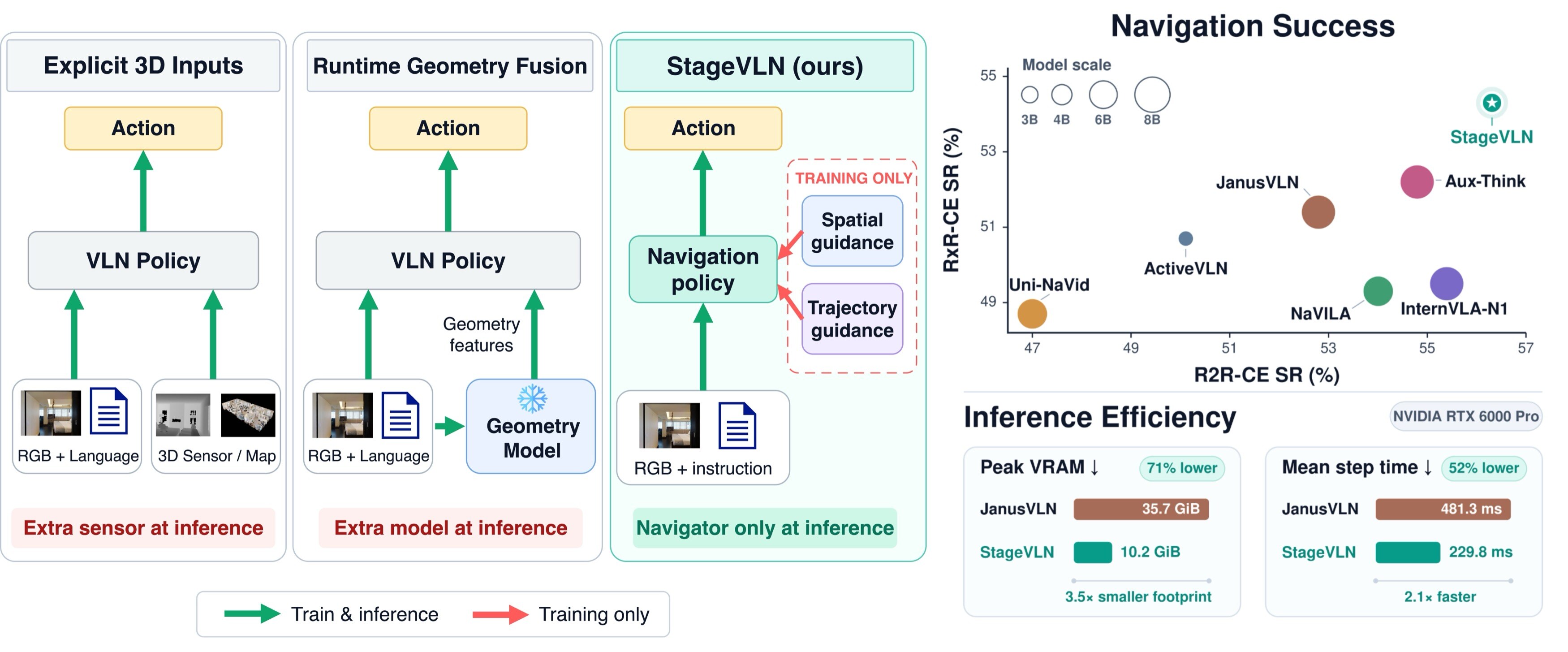
Overview. Left: three panels compare explicit 3D inputs (extra sensor at inference), runtime geometry fusion (extra model at inference) and StageVLN, whose spatial and trajectory guidance is used only in training so that only the navigator runs at inference. Right: a scatter plot of R2R-CE versus RxR-CE success rate where StageVLN is highest on both axes, and bar charts showing 10.2 GiB peak VRAM versus 35.7 GiB and 229.8 ms versus 481.3 ms step time for JanusVLN on an RTX 6000 Pro.
StageVLN overview. Left: explicit 3D inputs and runtime geometry fusion add a sensor or a model at inference; StageVLN uses spatial and trajectory guidance only during training and keeps the navigator alone at inference. Right: navigation success and inference efficiency (single NVIDIA RTX 6000 Pro).

Overview

  • 56.3% Success rate on R2R-CE val-unseen
  • 54.3% Success rate on RxR-CE val-unseen
  • 10.24 GiB Peak VRAM at inference
  • 4B Parameters at inference, no geometry encoder

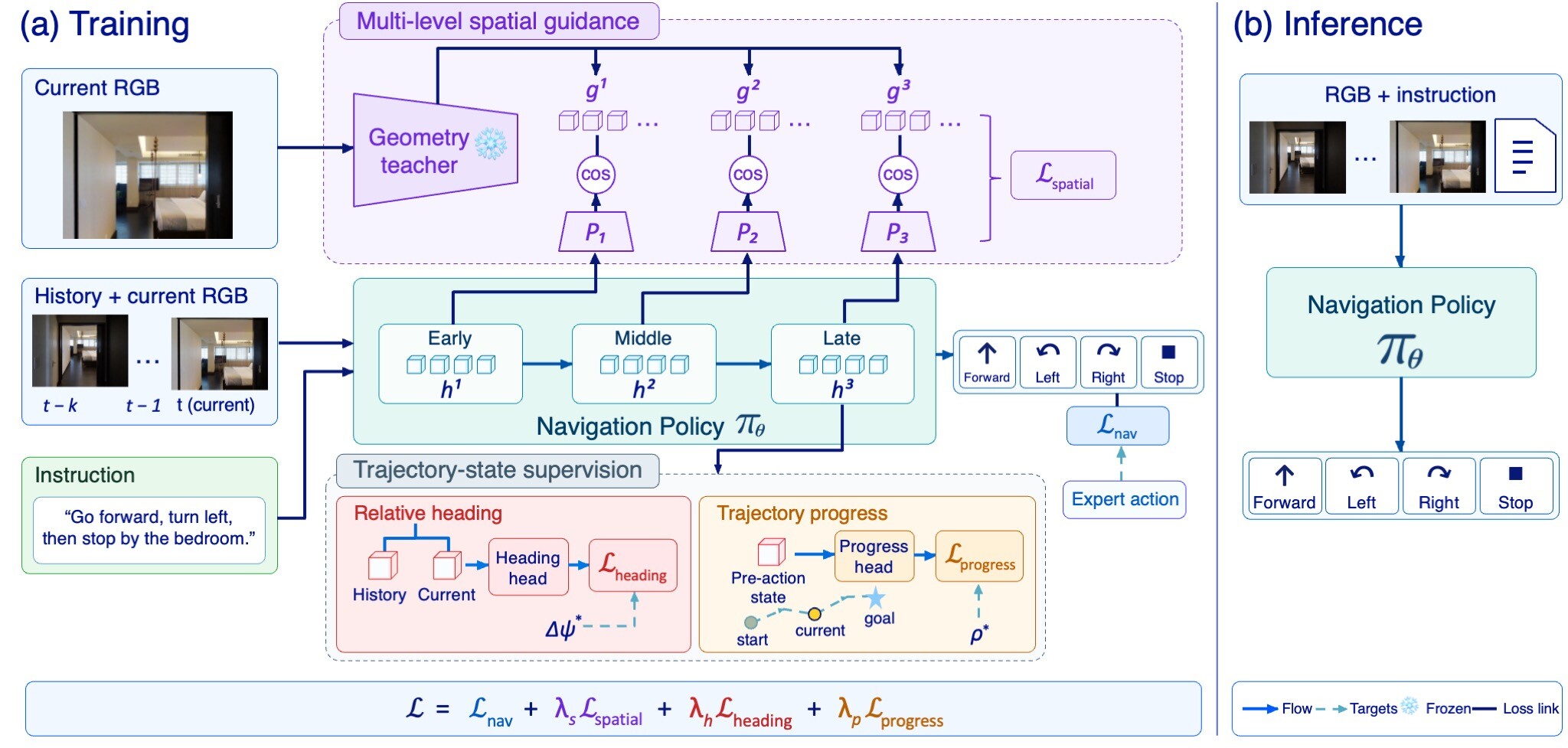
A frozen geometry foundation model and two trajectory objectives shape the navigator's hidden states during training. All of them are removed afterwards: at inference, StageVLN is a plain vision-language model that reads an instruction and a short history of single-camera RGB frames.

Abstract

Vision-and-Language Navigation (VLN) policies increasingly benefit from strong semantic priors provided by large vision-language models (VLMs). However, standard action supervision does not explicitly encourage intermediate representations to preserve scene geometry, relative orientation, or global episode progress. Incorporating depth estimators, explicit maps, point clouds, or geometry foundation models at inference can provide such structure but introduces additional computation, memory overhead, and architectural dependence during deployment. We introduce StageVLN, a training framework that shapes navigation representations through privileged spatial and trajectory guidance while preserving the original inference pathway. A frozen geometry foundation model provides multi-level spatial guidance to hierarchical navigator states, while relative-heading and expert-route progress objectives provide complementary trajectory-state supervision. All auxiliary components are used only during training and removed at deployment. On R2R-CE validation-unseen, StageVLN achieves 56.3% SR and 51.4% SPL with a 4B-parameter backbone, without an additional geometry encoder at inference. On RxR-CE, it achieves 54.3% SR without additional navigation training data or a geometry encoder at inference.

Method

Standard action supervision constrains what the policy outputs, but not whether its intermediate representations keep track of scene geometry or of where the agent is along the route. StageVLN adds three auxiliary training signals that go from local scene structure, to orientation across views, to the global state of the trajectory.

Training and inference pipeline. (a) Training: a frozen geometry teacher encodes the current RGB frame; projectors P1 to P3 map early, middle and late navigator hidden states to teacher features g1 to g3 under a cosine spatial loss. Below the navigator, a relative-heading head compares history and current states, and a progress head reads the pre-action state. The total loss is L = L_nav + lambda_s L_spatial + lambda_h L_heading + lambda_p L_progress. (b) Inference: RGB frames and the instruction go through the navigation policy alone, which outputs Forward, Left, Right or Stop.
Training and inference. During training, a frozen geometry teacher provides multi-level spatial guidance, while relative-heading and expert-route progress objectives supervise trajectory state. At inference, the teacher, alignment projectors and auxiliary heads are removed, leaving only the base RGB–language navigation policy.
  1. 1

    Multi-level spatial guidance

    A frozen geometry teacher (VGGT-Ω) encodes the current frame. Trainable projectors map the navigator's current-image tokens after layers 8, 16 and 24 to the teacher's aggregator features from layers 11, 17 and 23, and a cosine-distance loss aligns each pair.

    ℒspatial

  2. 2

    Relative heading

    For each selected history frame, a relation head predicts how much the agent has turned between that frame and the current one. The target is derived from the expert's turns and encoded as (sin Δψ, cos Δψ) to avoid the angle wrap-around.

    ℒheading

  3. 3

    Expert-route progress

    A progress head reads the hidden state just before the action token and predicts the fraction of the expert's forward moves already completed, with a soft-target binary cross-entropy loss. Reading the pre-action state keeps the ground-truth action out of view under teacher forcing.

    ℒprogress

ℒ = ℒnav + λsℒspatial + λhℒheading + λpℒprogress

ℒnav is the negative log-likelihood of the expert action; λs = 0.3, λh = λp = 0.1.

At inference

Only the navigator runs. It receives the instruction, up to eight history RGB frames and the current frame, and outputs one of MOVE_FORWARD, TURN_LEFT, TURN_RIGHT or STOP. No panorama, odometry, depth or geometry encoder is needed.

Implementation details
  • Navigator: Qwen3.5-4B. Geometry teacher: VGGT-Ω, frozen; it sees only the current frame.
  • Alignment projectors: LayerNorm and a two-layer MLP, 2560 → 4096 → 2048, with GELU. The heading and progress heads read layer 24; turns count as ±15° for the heading target.
  • Data: expert demonstrations only, 10,819 episodes from R2R-CE and 19,990 from RxR-CE, with no additional navigation datasets.
  • Optimization: AdamW, learning rate 10−6 for the language model and its output head and 10−5 for the visual merger, projectors and heads; the visual encoder is frozen. One epoch, global batch size 64, four NVIDIA H100 GPUs.

Results on R2R-CE and RxR-CE

With a 4B navigator, StageVLN reaches 56.3 SR / 51.4 SPL on R2R-CE and 54.3 SR / 42.8 SPL on RxR-CE (validation-unseen), without additional navigation training data or an extra geometry encoder at inference.

  • Highest OS and SR on R2R-CE, and highest SR and lowest NE on RxR-CE, among the listed methods.
  • Higher SR on both benchmarks than several larger 7B–8B models, including InternVLA-N1, NaVILA and JanusVLN.
  • Against JanusVLN, which keeps a 1B geometry encoder at inference, SR is 3.5 points higher on R2R-CE and 2.9 points higher on RxR-CE. SPL is 2.2 points higher on R2R-CE and 1.5 points lower on RxR-CE.

Comparison on the validation-unseen splits

Method Params Observation R2R-CE val-unseen RxR-CE val-unseen External
train data
Pano. Odo. Depth S.RGB NE↓OS↑SR↑SPL↑ NE↓SR↑SPL↑nDTW↑
Panorama, odometry and depth
HPN+DN–✓✓✓6.3140.036.034.0–––––
CMA–✓✓✓6.2052.041.036.08.7626.522.147.0–
Sim2Sim–✓✓✓6.0752.043.036.0–––––
VLN-BERT–✓✓✓5.7453.044.039.08.9827.022.646.7–
Ego2-Map–✓✓✓5.5456.047.041.0–––––
DreamWalker–✓✓✓5.5359.049.044.0–––––
GridMM–✓✓✓5.1161.049.041.0–––––
Reborn–✓✓✓5.4057.050.046.05.9848.642.063.3–
InstructNav–✓✓✓6.89–31.024.0–––––
Other sensor combinations
COSMO–✓–56.047.040.0–––––
AO-Planner–✓✓5.5559.047.033.07.0643.330.550.1–
LAW–✓✓✓6.8344.035.031.010.908.08.038.0–
MapNav–✓✓✓4.9353.039.737.2–––––
g3D-LF–✓✓✓5.7059.547.234.6–––––
Seq2Seq–✓✓7.7737.025.022.012.1013.911.930.8–
NaVid-4D–✓✓5.9955.743.837.1–––––
NavMorph–✓✓5.7556.947.933.28.8530.822.844.2–
Single RGB camera
NaVid7B✓5.4749.137.435.9––––953K
Sim2Real–✓5.9555.844.930.48.7936.725.518.10K
Uni-NaVid7B✓5.5853.347.042.76.2448.740.9–3577K
InternVLA-N18B✓4.8960.655.452.16.4149.541.862.651200K
StreamVLN*7B✓6.0553.845.541.6––––10033K
NaVILA*7B✓5.2262.554.049.06.7749.344.058.813132K
Aux-Think8B✓6.0860.054.846.96.2452.240.2–1600K
ActiveVLN3B✓5.3158.350.143.75.8450.741.258.10K
JanusVLN†7B + 1B✓5.1758.052.849.26.4651.444.359.10K
StageVLN (ours)4B✓5.1764.756.351.45.6554.342.858.30K

Bold: best; underlined: second best, over all 27 methods. *StreamVLN uses EnvDrop augmentation; NaVILA excludes human-following data. †Uses an additional geometry encoder at inference (parameters given as VLM + geometry encoder). External data counts exclude the data used to pretrain the base models.

Deployment efficiency

With a 4B navigator and nothing else at inference, StageVLN needs the least memory on both GPUs: 41.4% less peak VRAM than NaVILA, with step time 16.6% lower on the RTX 5090 and 40.0% lower on the RTX 6000 Pro. StreamVLN is faster but uses more memory. JanusVLN runs out of memory on the RTX 5090.

NVIDIA RTX 5090

MethodPeak allocated VRAM (GiB)↓Mean step time (ms)↓
JanusVLNOOM–
NaVILA17.47365.2
StreamVLN17.48233.4
StageVLN10.24304.5

NVIDIA RTX 6000 Pro

MethodPeak allocated VRAM (GiB)↓Mean step time (ms)↓
JanusVLN35.73481.3
NaVILA17.47383.1
StreamVLN17.48209.8
StageVLN10.24229.8

Baselines run with their released code and recommended configurations on our hardware. Bold: best within each GPU. OOM: out of memory under the tested configuration.

Ablations

All component ablations are on R2R-CE validation-unseen with VGGT as the geometry teacher; the headline model uses VGGT-Ω.

Components

Nav. Geo. Head. Prog. NE↓OS↑SR↑SPL↑
✓–5.1956.0146.4942.32
✓1L6.3361.8348.5041.86
✓ML6.1261.0152.2646.72
✓ML✓6.1763.3049.9743.80
✓ML✓5.6663.8953.1848.67
✓–✓✓5.8664.0654.4348.58
✓ML✓✓5.5867.3755.3648.44

First row: supervised fine-tuning (SFT). Highlighted row: full StageVLN. 1L aligns one layer pair (navigator 24 ↔ teacher 23); ML aligns all three. Bold: best.

Geometry teacher

TeacherNE↓OS↑SR↑SPL↑
VGGT5.5867.3755.3648.44
VGGT-Ω5.1764.7156.2851.37

Both variants use the full StageVLN objective with a frozen teacher.

  • Multi-level alignment beats single-level: 52.26 / 46.72 vs. 48.50 / 41.86 SR / SPL.
  • Trajectory supervision alone reaches 54.43 / 48.58; adding multi-level geometry raises SR to 55.36 and OS to 67.37 and lowers NE to 5.58, with similar SPL.
  • Full StageVLN improves SR / SPL over SFT by 8.87 / 6.12 points, although NE stays higher (5.58 vs. 5.19).
  • The teacher matters: VGGT-Ω gives the best NE, SR and SPL; VGGT the best OS.

Simulation and real-world rollouts

Simulation: StageVLN vs. JanusVLN

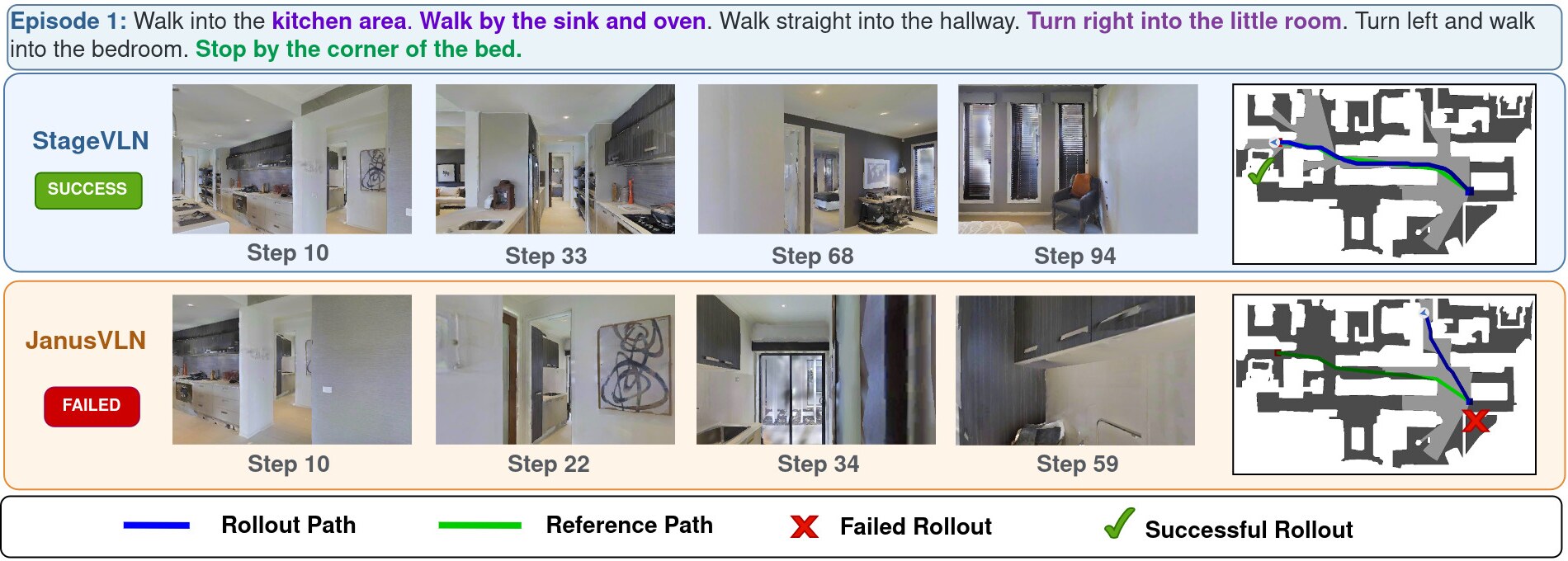
Same instruction, same start. StageVLN follows the reference route and reaches the goal; JanusVLN leaves the intended route early in the rollout and fails.

Episode 1: walk into the kitchen area, walk by the sink and oven, walk straight into the hallway, turn right into the little room, turn left and walk into the bedroom, stop by the corner of the bed. StageVLN (success) frames at steps 10, 33, 68 and 94 with a top-down map where its path follows the reference path. JanusVLN (failed) frames at steps 10, 22, 34 and 59 with a map where its path leaves the reference path.
A simulated episode in Habitat. Top-down maps: rollout path, reference path.

Real world: Unitree G1 humanoid

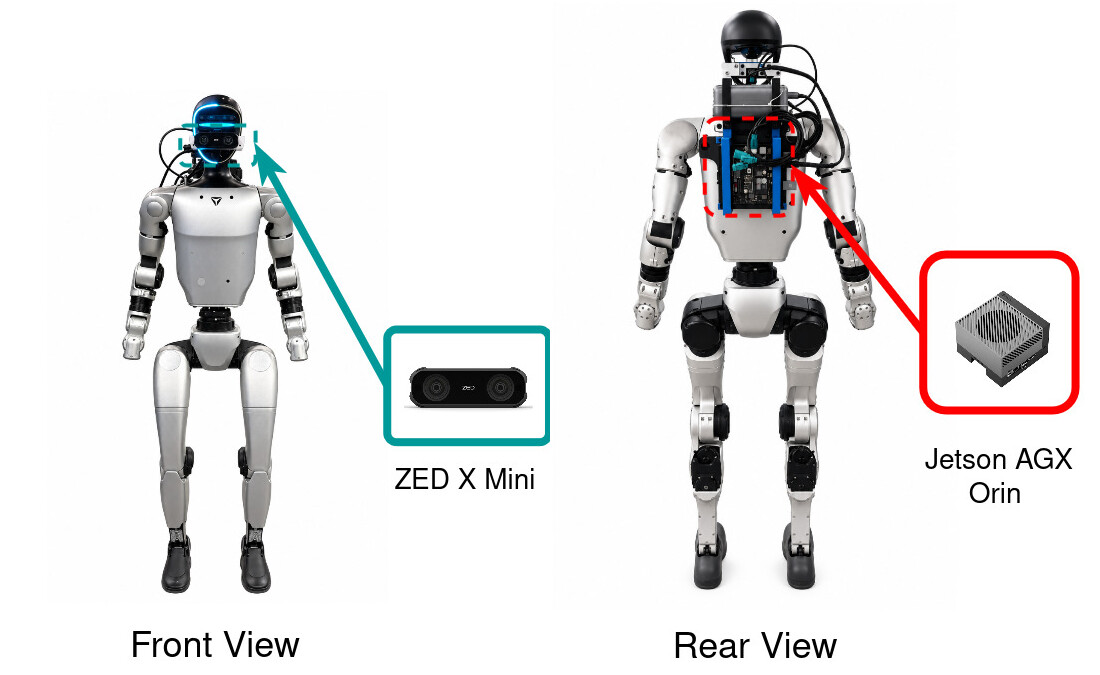
StageVLN runs on a Unitree G1 with a ZED X Mini camera. A Jetson AGX Orin on the robot preprocesses images and communicates with a remote workstation, where an NVIDIA GeForce RTX 5090 runs the policy. The policy receives only RGB observations and the instruction. It was not fine-tuned on any real-world data, yet it completed all five instructions below, through corridors, intersections and doorways and past referenced objects, stopping close to the instructed goals.

Front and rear views of the Unitree G1 humanoid: a ZED X Mini camera is mounted on the head and a Jetson AGX Orin on the back.
The G1 platform: ZED X Mini camera (front), Jetson AGX Orin (back).

Real-world videos

2× speed

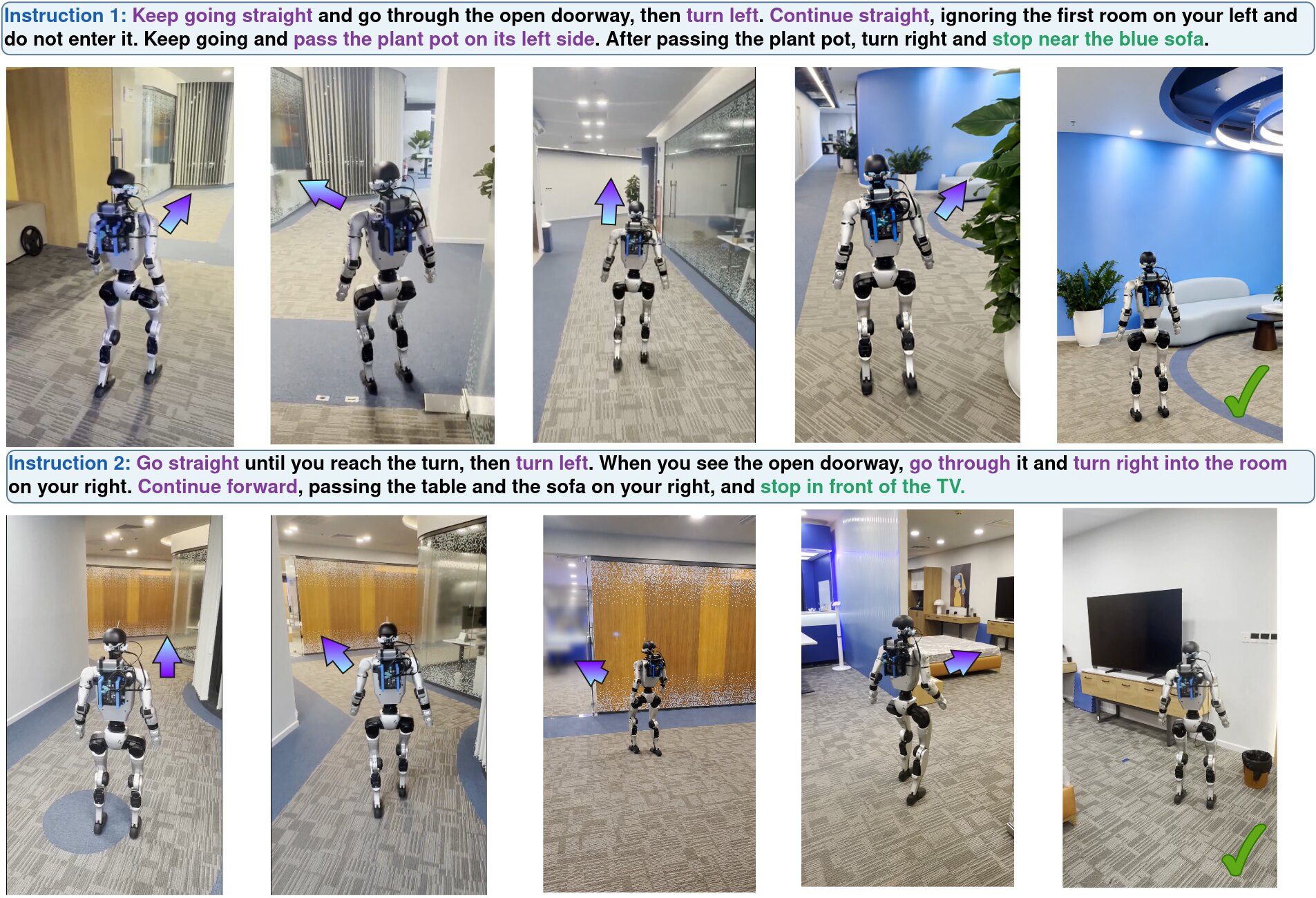
Instruction 1: Keep going straight and go through the open doorway, then turn left. Continue straight, ignoring the first room on your left and do not enter it. Keep going and pass the plant pot on its left side. After passing the plant pot, turn right and stop near the blue sofa.
2× speed

Instruction 2: Go straight until you reach the turn, then turn left. When you see the open doorway, go through it and turn right into the room on your right. Continue forward, passing the table and the sofa on your right, and stop in front of the TV.

2× speed

Instruction 3: Go straight until you reach the white cabinet. Move to the right side of the cabinet to pass it, then go through the open doorway. Stop near the green plant pot.

Third-person recordings at 2× speed. The Instruction 3 video starts 10 s into the recording.

Two real-world runs in an office, five frames each in chronological order. Instruction 1: keep going straight through the open doorway, turn left, continue straight past the first room on the left, pass the plant pot on its left side, then turn right and stop near the blue sofa. Instruction 2: go straight to the turn, turn left, go through the open doorway and turn right into the room, continue past the table and sofa on the right and stop in front of the TV. Both runs end with a check mark.
Instructions 1 and 2: two real-world runs, frames in chronological order; arrows show the direction taken.

Three more real-world instructions

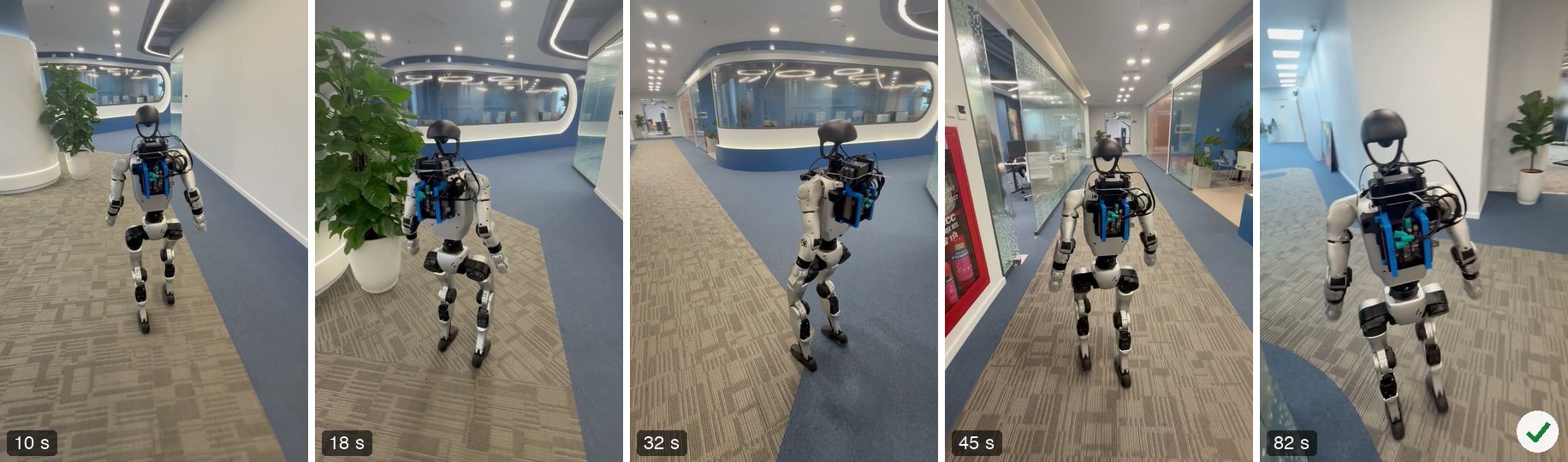
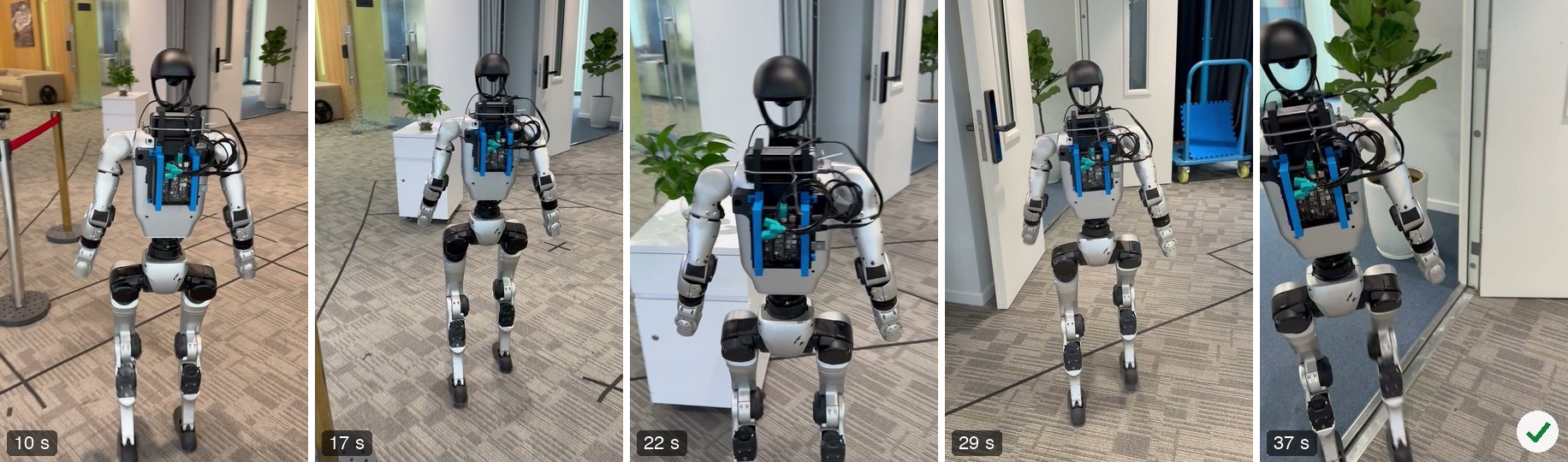
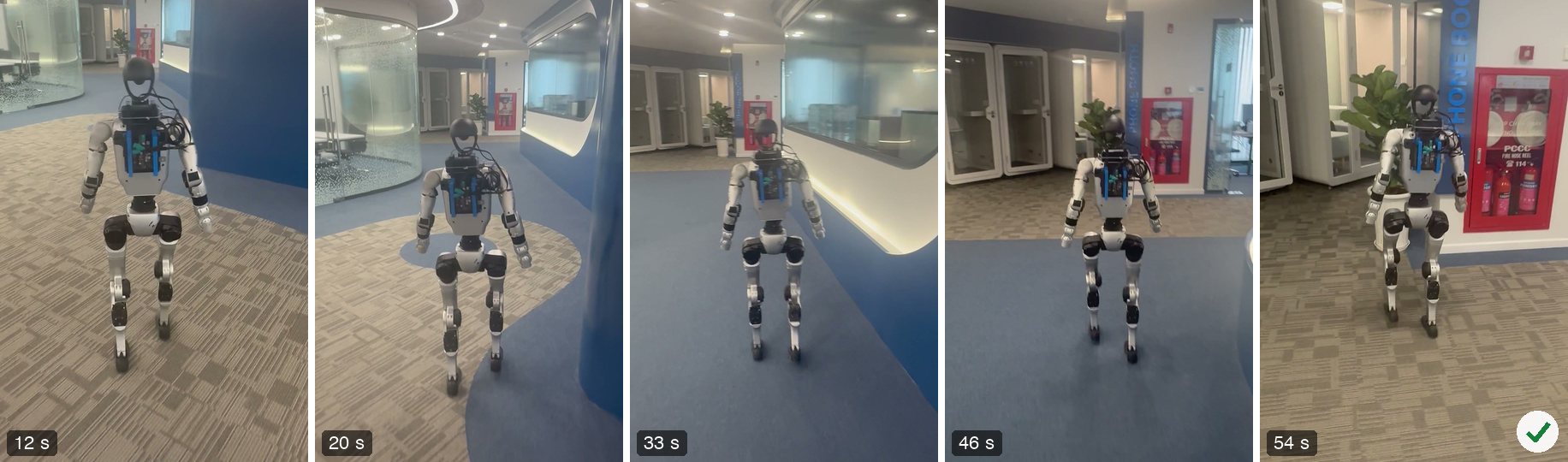
Each run below passes a landmark on a stated side or turns at an intersection, and ends at a goal defined by nearby objects. Frames are third-person views in chronological order; each label is the time since the start of the recording, and the check mark is the final stop. These are qualitative examples, not a success-rate evaluation.

Instruction 3: Go straight until you reach the white cabinet. Move to the right side of the cabinet to pass it, then go through the open doorway. Stop near the green plant pot.

Instruction 3, five frames at 10, 17, 22, 29 and 37 seconds: the G1 walks straight to a white cabinet, moves to the cabinet's right side to pass it, goes through an open doorway and stops next to a green plant pot.

Instruction 4: Go straight then turn right. Continue straight until you reach the intersection, then veer slightly to the right. Stop at the position between the green plant pot and the fire extinguisher box.

Instruction 4, five frames at 12, 20, 33, 46 and 54 seconds: the G1 turns right, walks along a corridor past glass rooms, veers slightly right at the intersection and stops between a green plant pot and a red fire extinguisher box.

Instruction 5: Go straight, passing the plant on its left side. Continue straight until you reach the intersection, then turn left. Keep going straight and stop near the plant at the end of the hallway.

Instruction 5, five frames at 10, 18, 32, 45 and 82 seconds: the G1 walks past a large potted plant, turns left at the intersection, walks down a long hallway and stops near the plant at its end.

Citation

BibTeX
@article{dao2026stagevln,
  title={StageVLN: Spatial and Trajectory Auxiliary Guidance for Efficient Vision-Language Navigation},
  author={Dao, Anh and Pham, Quan-Dung and Vinh, Le Danh and Nguyen, The Anh and Pham, Nguyen Viet Tri and Chen, Yiyu and Le, Pham Tuyen and Nguyen, Van-Truong and Nguyen, Quan},
  journal={arXiv preprint arXiv:2610.05664},
  year={2026}
}